Retrievers and rerankers · 2026
Rank-R1
Reinforcement learning for reasoning in LLM-based document reranking.
Abstract
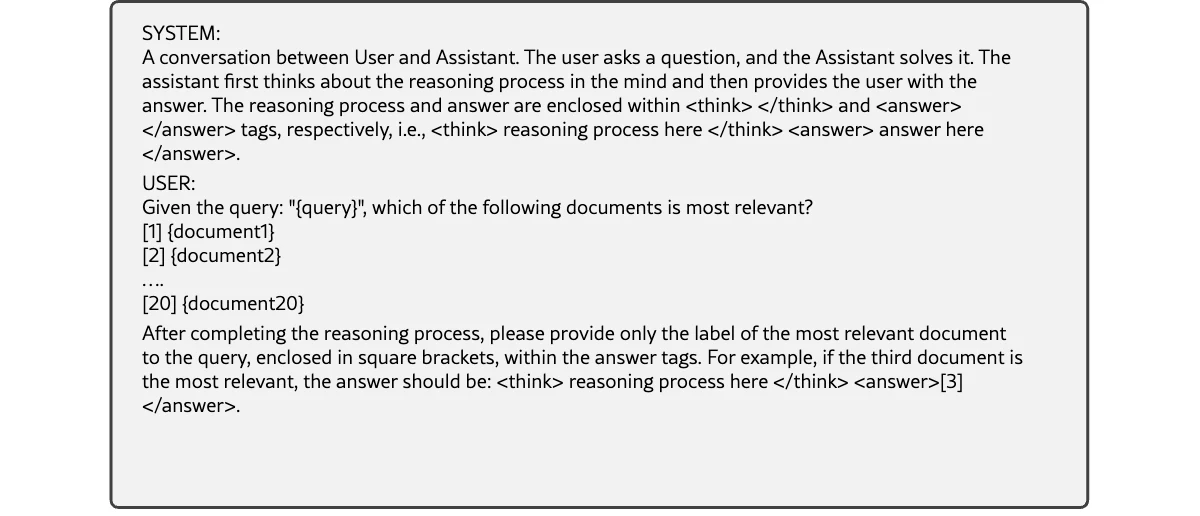
This paper introduces Rank-R1, a novel LLM-based reranker that performs reasoning over both the user query and candidate documents before performing the ranking task. Existing document reranking methods based on LLMs typically rely on prompting or fine-tuning to order or label candidate documents. For Rank-R1, a reinforcement learning algorithm (specifically Group Relative Policy Optimization, GRPO) is used along with only a small set of relevance labels — without any reasoning supervision — to enhance the reasoning ability of LLM-based rerankers. Given a query and candidate documents, the reranker generates reasoning steps before selecting the most relevant document; the reward signal is determined only by whether the model correctly identifies the most relevant document. Experiments on TREC DL and BRIGHT datasets show Rank-R1 achieves in-domain effectiveness at par with supervised fine-tuning using only 18% of the training data, and largely outperforms zero-shot and fine-tuned baselines on out-of-domain complex-query datasets, with the 14B model surpassing zero-shot GPT-4 on BRIGHT. Reasoning also improves explainability of ranking results.
Papers
2026SIGIR 2026cited 107×
Rank-R1: Enhancing Reasoning in LLM-based Document Rerankers via Reinforcement Learning
Shengyao Zhuang, Xueguang Ma, Zheng Yao, Shuai Wang, Bevan Koopman, Jimmy Lin, Guido Zuccon
Retrievers and rerankers
Retrievers and rerankers · 2026
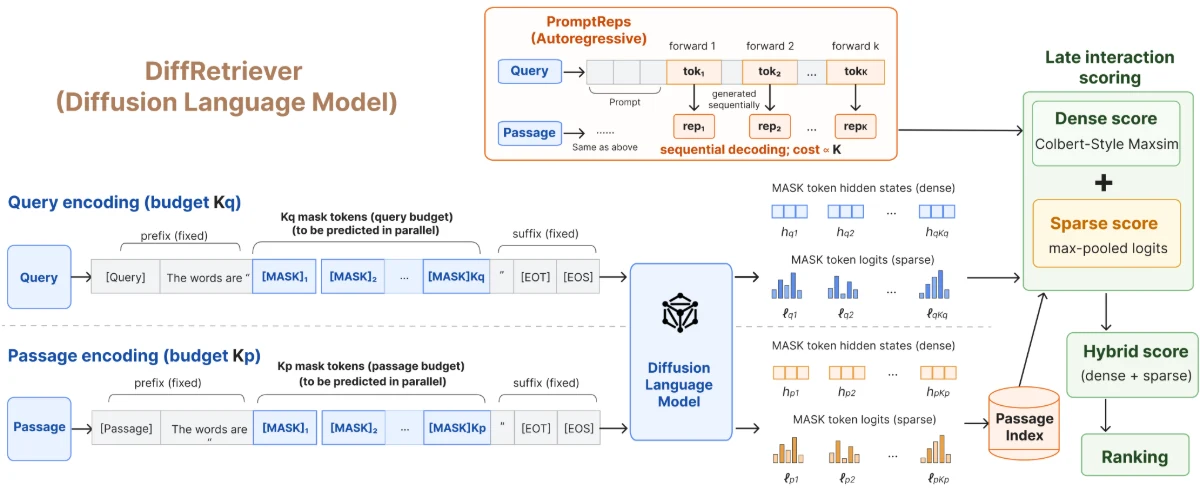
DiffRetriever
Parallel masked positions in a diffusion language model produce multiple representations for dense and sparse retrieval.
Retrievers and rerankers · 2026
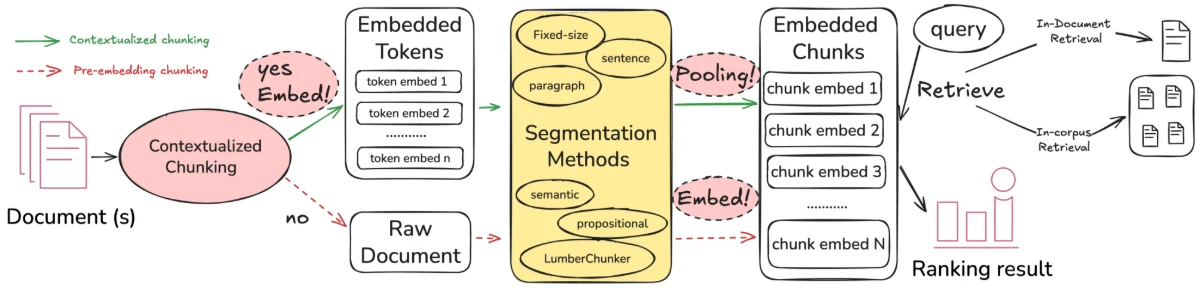
Beyond Chunk-Then-Embed
A unified framework for comparing document segmentation and embedding strategies across retrieval tasks.