Retrievers and rerankers · 2024
LLMs for Stemming
Comparing stemming techniques and examining the promises and limitations of language models for stemming.
Abstract
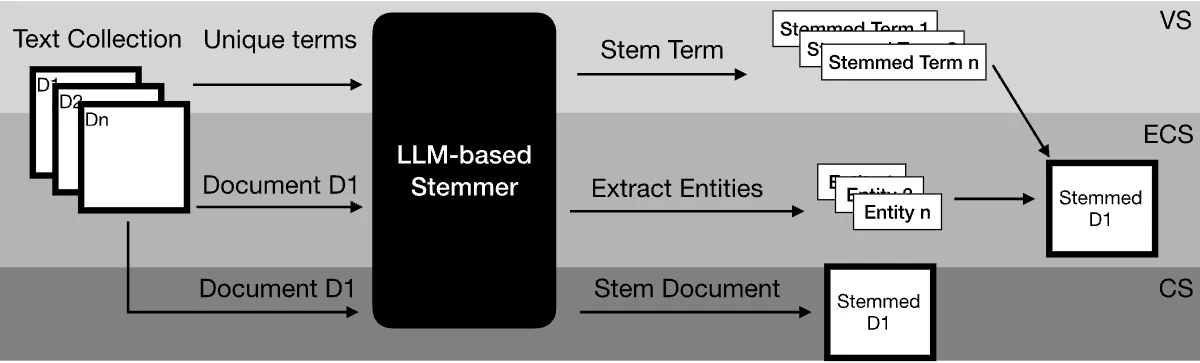
Text stemming is a natural language processing technique that is used to reduce words to their base form, also known as the root form. The use of stemming in IR has been shown to often improve the effectiveness of keyword-matching models such as BM25. However, traditional stemming methods, focusing solely on individual terms, overlook the richness of contextual information. Recognizing this gap, in this paper, we investigate the promising idea of using large language models (LLMs) to stem words by leveraging its capability of context understanding. With this respect, we identify three avenues, each characterised by different trade-offs in terms of computational cost, effectiveness and robustness : (1) use LLMs to stem the vocabulary for a collection, i.e., the set of unique words that appear in the collection (vocabulary stemming), (2) use LLMs to stem each document separately (contextual stemming), and (3) use LLMs to extract from each document entities that should not be stemmed, then use vocabulary stemming to stem the rest of the terms (entity-based contextual stemming). Through a series of empirical experiments, we compare the use of LLMs for stemming with that of traditional lexical stemmers such as Porter and Krovetz for English text. We find that while vocabulary stemming and contextual stemming fail to achieve higher effectiveness than traditional stemmers, entity-based contextual stemming can achieve a higher effectiveness than using Porter stemmer alone, under specific conditions.
Papers
2024SIGIR 2024cited 13×First author
Large Language Models Based Stemming for Information Retrieval: Promises, Pitfalls and Failures
Shuai Wang, Shengyao Zhuang, Guido Zuccon
Retrievers and rerankers
Retrievers and rerankers · 2026
DiffRetriever
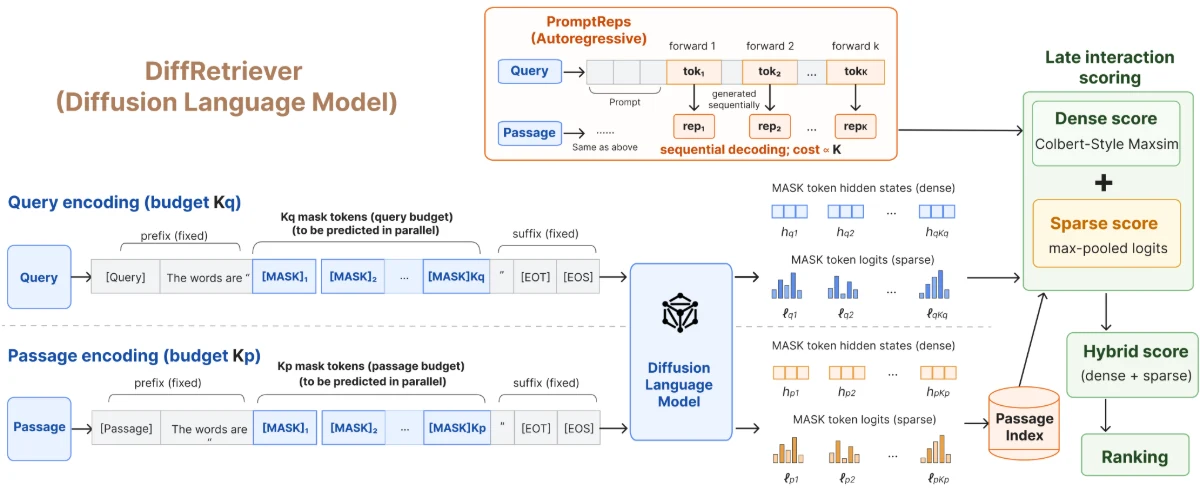
Parallel masked positions in a diffusion language model produce multiple representations for dense and sparse retrieval.
Retrievers and rerankers · 2026
Beyond Chunk-Then-Embed
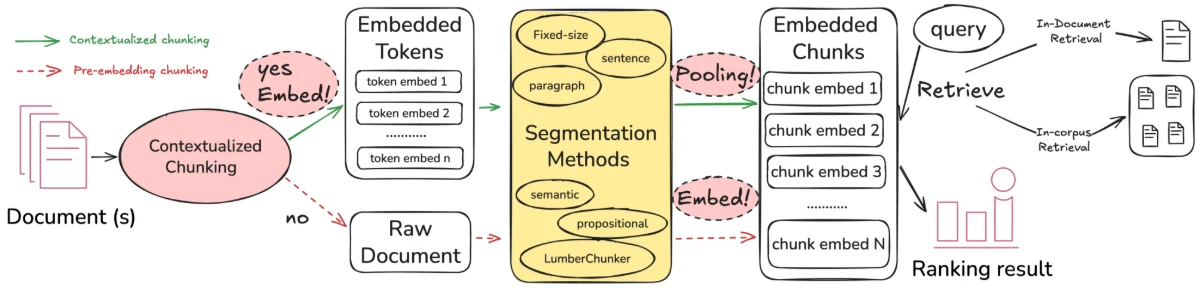
A unified framework for comparing document segmentation and embedding strategies across retrieval tasks.